


OhmCorr Test System™ Resistivity Meter
Assess corrosion risk in reinforced concrete with precision subsurface measurements.
Overview
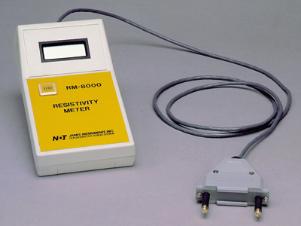
The OhmCorr™ Resistivity Meter measures electrical resistance within concrete to evaluate potential corrosion rates of embedded reinforcement. By taking readings from shallow drilled holes rather than the surface, OhmCorr™ avoids the measurement errors caused by carbonation and surface variability—delivering more reliable data for structural assessments.
Key Benefits
- Subsurface accuracy — Dual probes placed in 8mm (3/8") drilled holes bypass surface interference from carbonation
- Direct digital readout — Resistivity values displayed instantly on a 4½-digit LCD
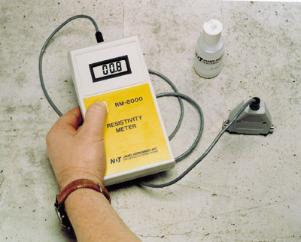
- Simple operation — Fill holes with conductive gel, position probes, activate the switch
- Integrated diagnostics — Pair with the CorMap™ System to generate resistivity plots and half-cell potential maps for comprehensive corrosion analysis
How it works
Corrosion in reinforced concrete is an electrochemical process driven by ionic movement through the cement matrix. When chlorides, carbonation, or other contaminants penetrate the concrete, conductivity increases and resistivity drops—accelerating corrosion of the steel reinforcement.
OhmCorr™ quantifies this relationship. Two probes spaced 5cm (1.97") apart are inserted into shallow holes filled with conductive gel. The meter measures resistance and displays resistivity in kilohm-centimeters, which correlates directly to corrosion potential:
| Resistivity (kΩ·cm) | Indicated Corrosion Rate |
|---|---|
| < 5 | Very high |
| 5 – 10 | High |
| 10 – 20 | Moderate to low |
| > 20 | Insignificant |
Specifications
| Parameter | Value |
|---|---|
| Range | 0.5 – 20 kΩ·cm |
| Resolution | ± 0.1 kΩ·cm (± 1 digit) |
| Display | 4½-digit LCD |
| Battery | 9V |
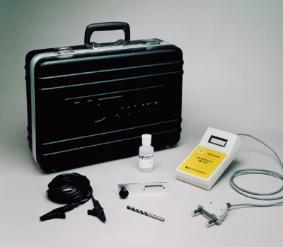
| Weight (with case) | 8 lbs (4 kg) |
What You'll Need
Consumable: C-RM 8045 Conductive Gel (required for probe contact)